
Most founders spend their first $5,000 backwards.
They start with a logo, a custom design and an annual plan for every tool. Then they build for three months. Then, with the money gone, they go looking for customers.
The data on this order is not kind. The Startup Genome Project studied 3,200 high-growth startups and found that 74% of the ones that failed did so by scaling too early: spending ahead of what they had proven. CB Insights' study of 431 recent shutdowns found poor product-market fit as the most common root cause, in 43% of them.
Both point to the same mistake: spending on the build before anyone has shown they will pay.
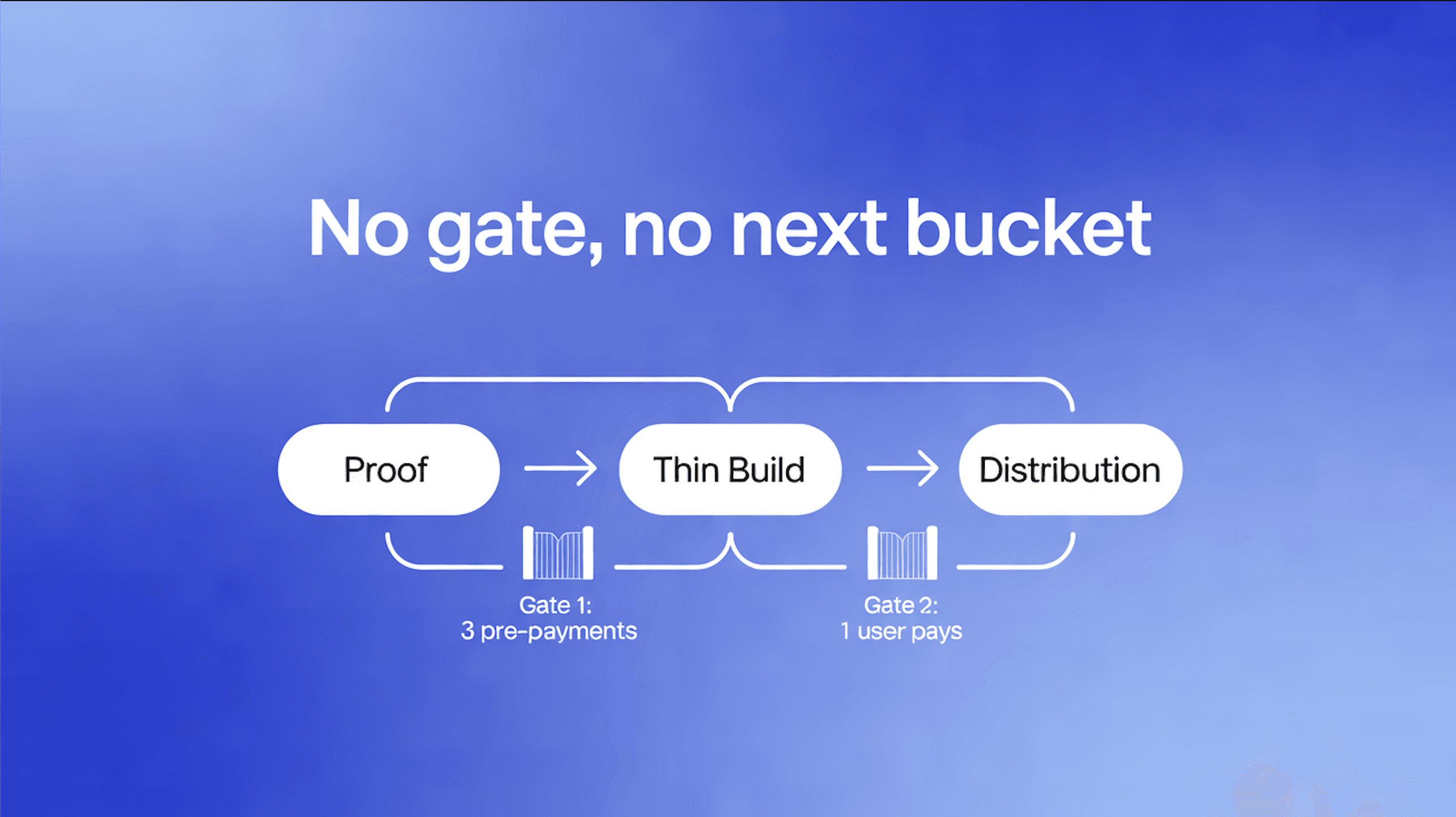
The First $5K Map flips the order. Your budget splits into three buckets, and each one stays locked until the one before it passes a gate. A gate is a number you either hit or you don't. No feelings, no "it's going well."
Here is the map.
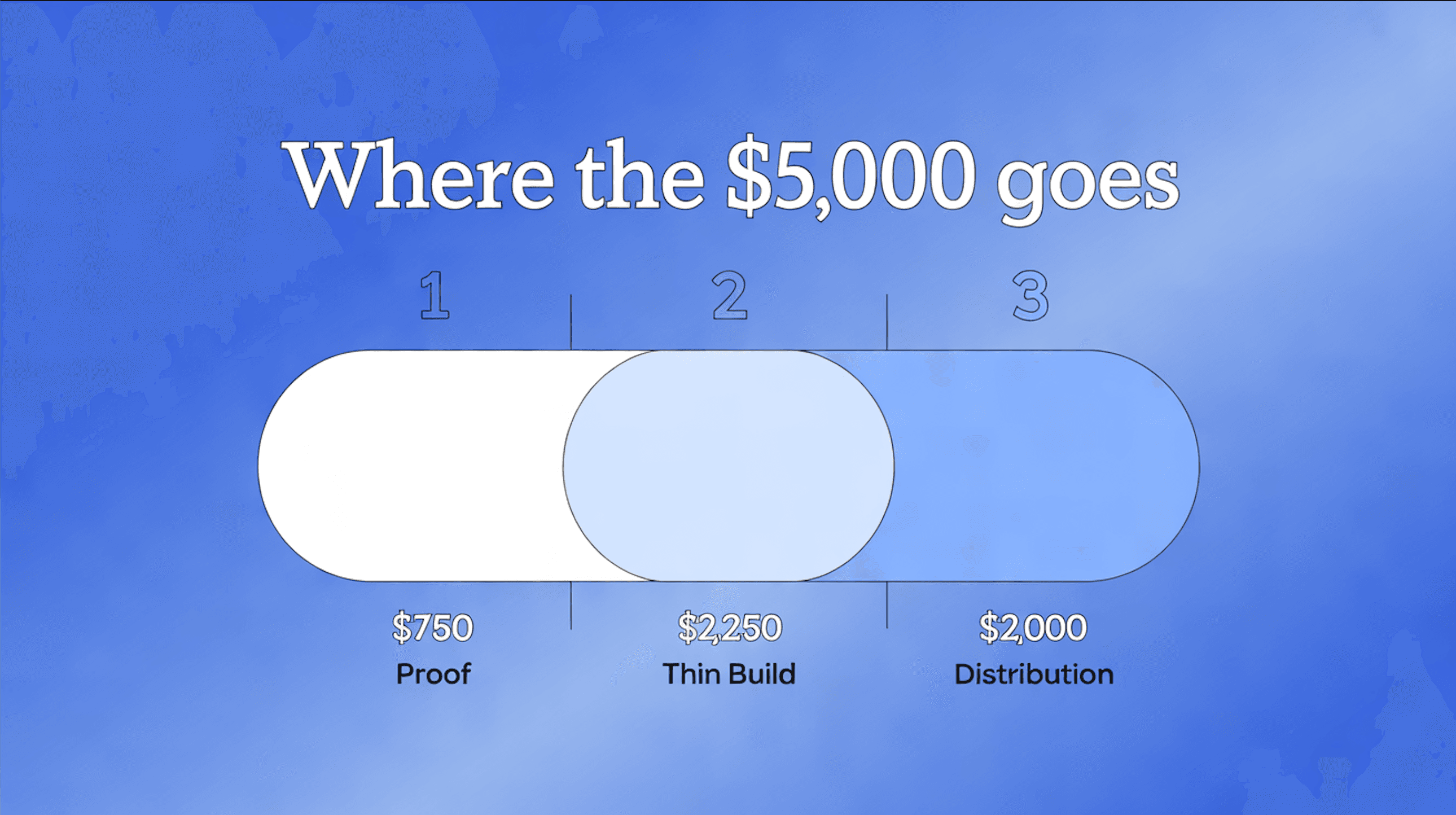
Bucket 1: Proof — $750 (15%)
Job: find out if anyone will pay before you build anything.
This is the cheapest money you will ever spend, and the most skipped.
- List 50 real people who have the problem. Names, not personas. If you can't name 50, you don't know your customer yet.
- Have ten conversations. Write down what they say in their own words. Those words become your landing page, your pitch and your spec.
- Put up one page that takes sign-ups or pre-payments. Not a product. A page with a promise and a button.
Gate 1: 10 conversations done, and 3 pre-payments or booked calls.
Not there? Change the problem or the customer, list a new 50 and run it again. Bucket 2 stays shut. Losing $750 here is how you avoid losing $5,000 later.
Bucket 2: Thin build — $2,250 (45%)
Job: one flow, for one kind of user, that takes one payment.
Not a platform. Not a dashboard. The single path from "I have this problem" to "I paid to fix it."
- Write a one-page spec and show it to ten target users first. If they don't recognize their problem in it, the build is already wrong.
- Build with common tools any developer you hire later already knows. Clever stacks are a tax on your future self.
- Pay for tools monthly, never annually. You don't know yet which ones you'll keep.
Gate 2: 5 people from your 50 finish the flow, and 1 pays.
Not there? Watch them use it without speaking. Every pause and wrong click is a fix. Fix what stopped them before you spend a dollar on reach.
Bucket 3: Distribution — $2,000 (40%)
Job: one channel, for 90 days.
Not five channels for two weeks each. One, long enough to learn whether it works.
- Go where your users already ask the question. Forums, communities, comment sections. Don't build an audience from zero when one already exists.
- Send ten messages a day for 14 days before you pay for a single ad. Ads only amplify a message that already converts by hand.
- Make one recording a week and cut it into posts. One piece of thinking, many formats.
- Hold a third back. On day 30, put it wherever the replies came from.
Four documents before any code
Builders read documents, not minds. Whether you hire a developer, use a no-code tool or build it yourself, these four pages decide whether the build matches what you meant.
- Problem brief. Who has the problem and what it costs them, in their words.
- The list of 50. Names, not personas.
- Price guess. One number, tested with a pre-payment.
- 30-day plan. What you do each week, and what counts as done.
If you can't write all four, you're not ready to spend Bucket 2.
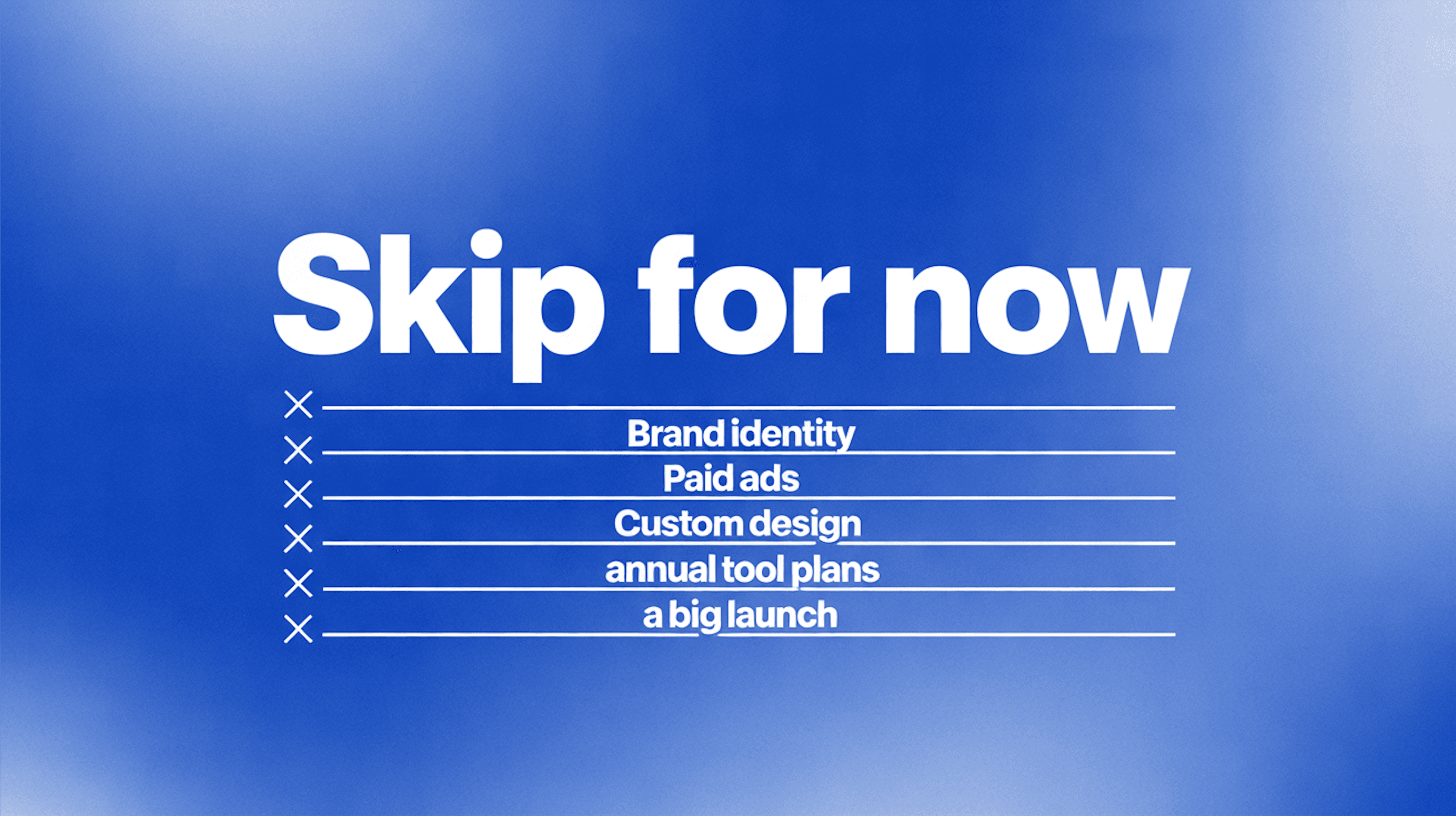
Skip for now
Each of these feels like progress. Each one has a moment when it's worth buying. That moment isn't now.
- Brand identity — when strangers are paying.
- Paid ads — when a message already converts by hand.
- Custom design — when users stay despite the plain version.
- Annual tool plans — when you've used the tool every week for three months.
- A big launch — when ten users would recommend it.
Spend in order
The map isn't about spending less. It's about spending in the right order.
$750 tells you whether to spend the next $2,250. The $2,250 tells you whether to spend the last $2,000. Every gate you pass makes the next dollar safer.
First proof. Then a thin build. Then one channel. Nothing opens early.
Stuck on a step? DM me the step you're on. Nothing for sale. If this helped, save it for the day you're about to buy a logo.
— Ayoub · @iayvob
A planning template, not financial or legal advice.