Most non-technical founders get robbed.
They hand a vaguely written five-page Google Doc to a dev shop and get quoted $30,000. Or they fall for the "no-code is completely free" trap, spend eight months learning how to wire up visual logic, and completely miss their market window.
The data on non-technical builds is brutal. Founders without a tech background over-index on visual design and completely under-fund their backend architecture and distribution. They end up with a beautiful app that crashes when three users log in, and zero budget left to market it.
The MVP Map for non-technical founders flips the dynamic. You are not buying a finished product; you are buying execution in strict phases. Your budget splits into three buckets. Each one stays locked until the one before it passes a hard gate.
You control the capital. You control the gates. Here is the map.
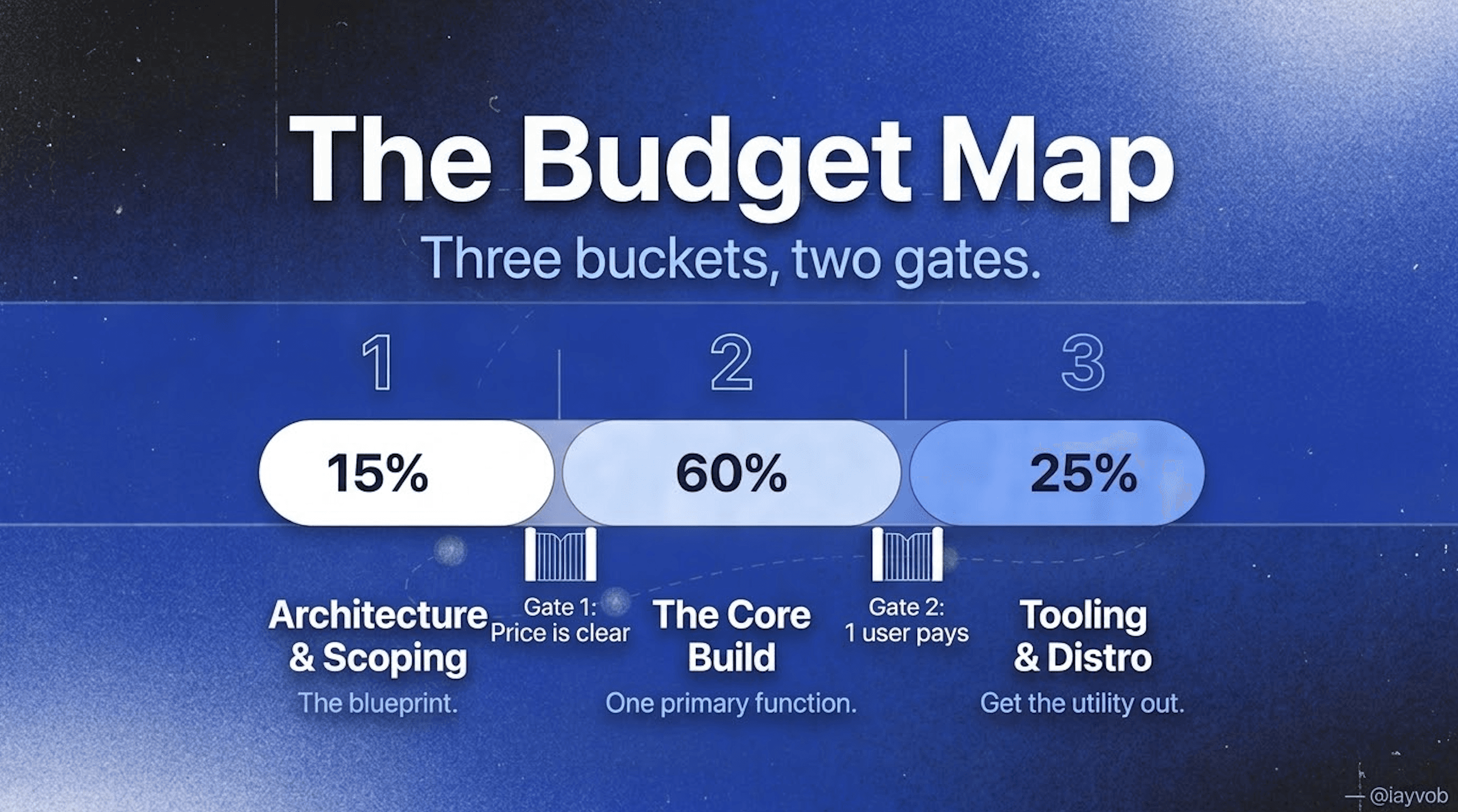
Bucket 1: Architecture & Scoping — 15%
Job: define the exact logic, database, and constraints before hiring anyone.
This is the highest-ROI money you will ever spend. Non-technical founders bleed cash when developers have to guess what they want.
- Pay for a technical blueprint. Hire a fractional CTO or a senior architect for five hours. Have them map your data models, API needs, and user flows.
- Define the stack. Force the decision to use standard, boring technology. React, Next.js, standard SQL. Do not let a freelancer build your MVP on a fringe framework just because they want to learn it.
- Cut the scope in half. Take the blueprint and brutally strip out everything that isn't the core utility.
Gate 1: A developer can price the build within a 10% margin without asking clarifying questions.
Not there? Your scope is too vague. Go back and clarify the logic. Bucket 2 stays shut. Losing a few hundred dollars on scoping prevents losing $15,000 on a botched build.
Bucket 2: The Core Build — 60%
Job: one primary function, wired to standard infrastructure, that takes payments.
You are not building a platform. You are building a single utility that solves one painful problem.
- Hire for execution, not strategy. You already have the blueprint. Hire a specialized developer to execute exactly what is on the page.
- Use off-the-shelf infrastructure. Do not let them build a custom auth system or email server. Plug in Clerk for auth, Resend for emails, and Paddle for payments. Pay for the APIs; don't pay for the development time to reinvent them.
- Set milestone payments. Never pay 50% upfront and 50% on completion. Pay weekly based strictly on demonstrable, working features.
Gate 2: The core loop works end-to-end, and one stranger successfully pays for it without the app crashing.
Not there? Stop development. Do not build the "settings" page or the "user profile" dashboard. Fix the core loop until money can change hands smoothly.
Bucket 3: Tooling & Distribution — 25%
Job: keep the lights on and get the utility into the market.
An MVP without a distribution budget is just an expensive hobby.
- Budget for the operational tax. You will need monthly subscriptions for your database, server hosting, and API limits. Keep these on monthly tiers.
- Buy attention for the finished flow. Your app works. Now put it where the problem lives. Use the remaining budget to drive targeted traffic to the exact flow you just built.
- Turn the build process into assets. Document the brutal reality of building this as a non-technical founder. That transparency is your primary marketing engine.
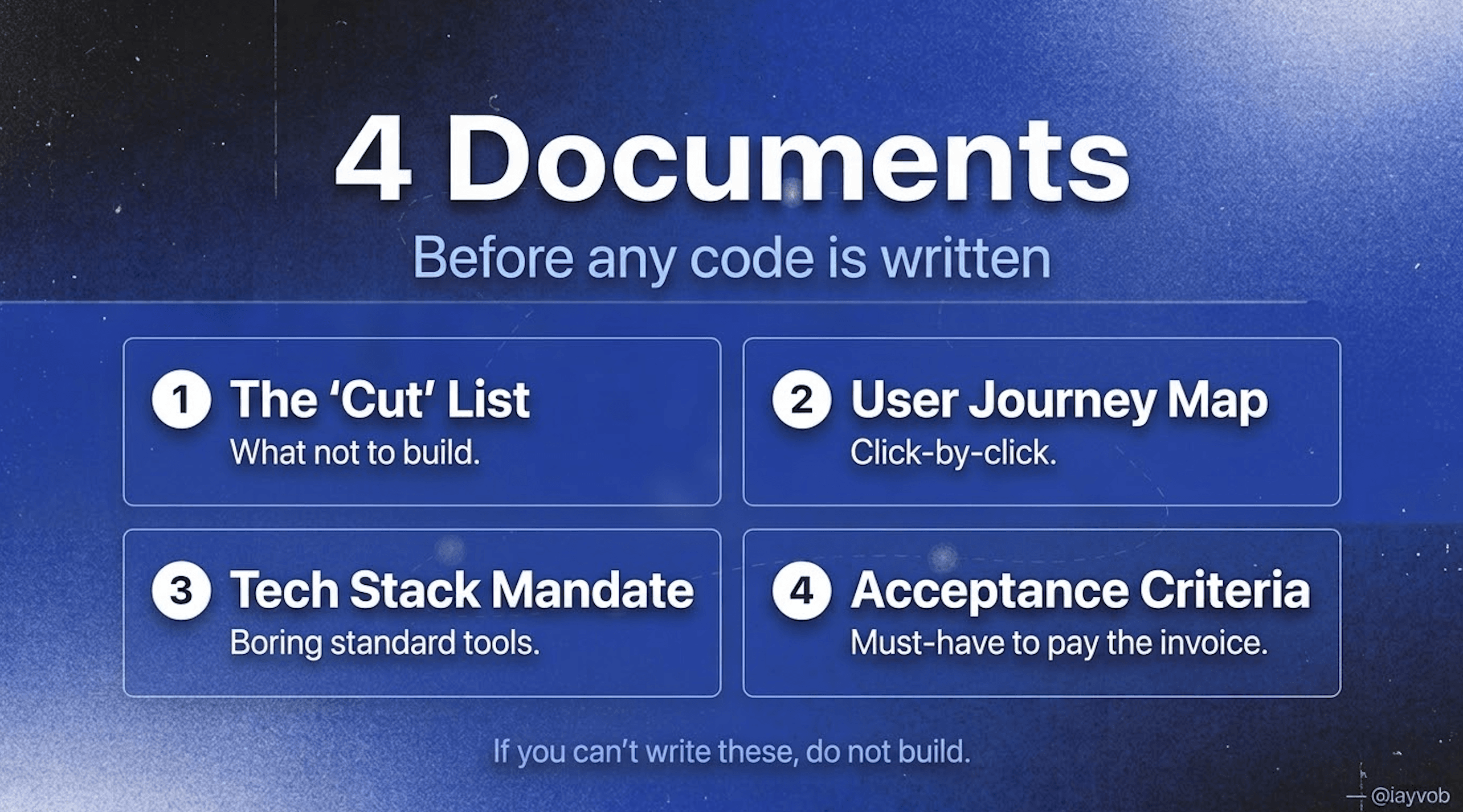
Four documents before any code
Developers read documentation, not minds. If you are non-technical, your only defense against bad code is crystal-clear documentation. These four pages dictate whether the developer builds what you actually meant.
- The "Cut" List. A literal list of features you explicitly forbid the developer from building right now.
- The User Journey Map. Click-by-click. What happens when they log in? Where does the data go? What is the error message if it fails?
- The Tech Stack Mandate. The exact APIs and frameworks to be used (e.g., standard React, Resend, Paddle). No deviations without written permission.
- Acceptance Criteria. A checklist of exactly what must function flawlessly before the final invoice is paid.
If you cannot produce all four, do not open Bucket 2.
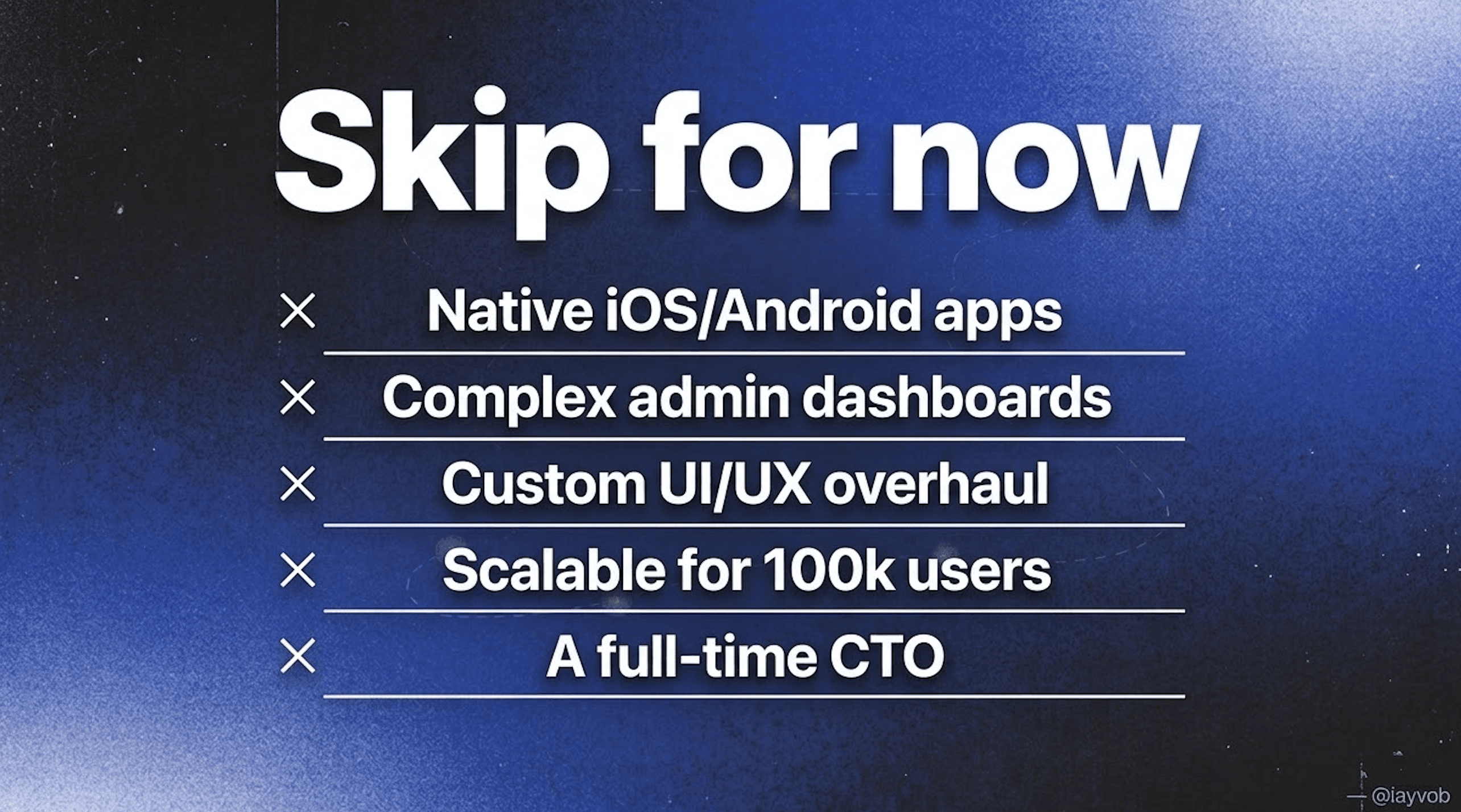
Skip for now
As a non-technical founder, you will be tempted to buy things that make you feel like a "real" tech company. None of these matter today.
- Native iOS/Android apps — when your web app actually retains users.
- Complex admin dashboards — when you have too much data to manage in a standard spreadsheet.
- A custom UI/UX overhaul — when the ugly, functional version proves people want the solution.
- Scalability for 100,000 users — when you actually hit 1,000.
- A full-time CTO — when you have the revenue to pay their salary.
Spend in order
This map is not about doing it cheaply. It is about doing it ruthlessly.
The first 15% ensures the next 60% isn't wasted. The 60% ensures the final 25% actually has something to sell. Every gate you pass transfers leverage back to you.
First the architecture. Then the utility. Then the distribution. Nothing opens early.
Stuck managing a developer right now? DM me the step you're on. Nothing for sale. If this helped, save it for the day you're about to approve a $20k agency quote.
— Ayoub · @iayvob
A strategic framework, not financial or legal advice.